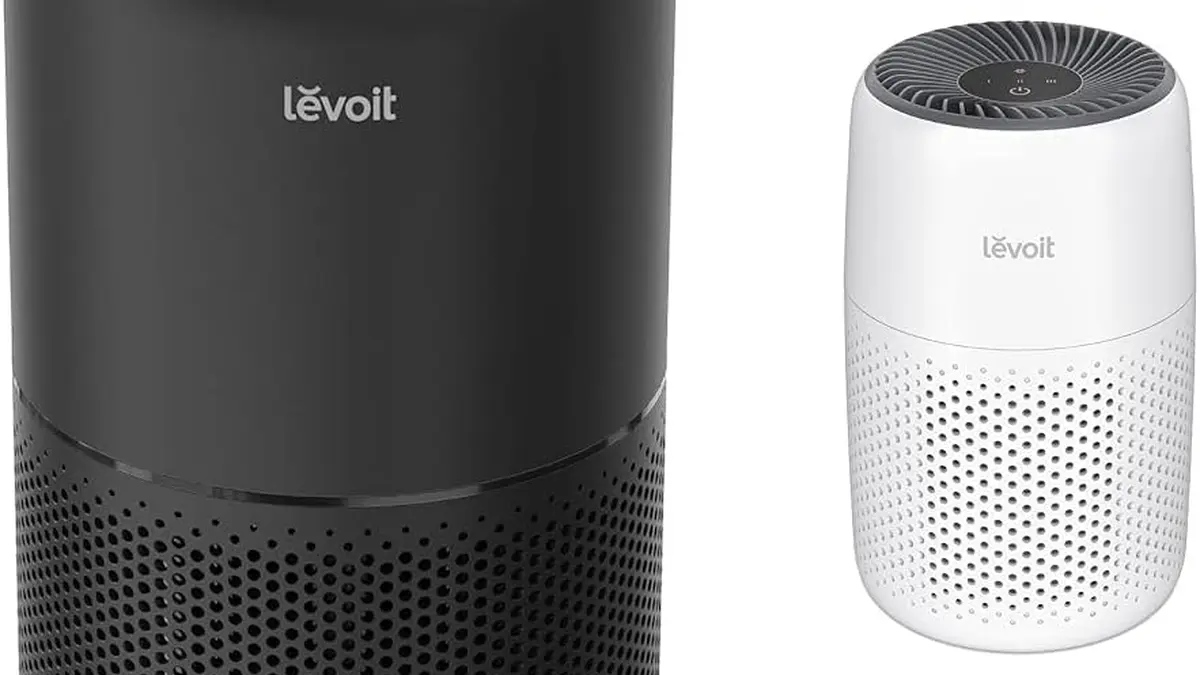
The Levoit Core300-P is rated at 143 CFM of clean air delivery and the Levoit Core Mini-P at 34 CFM, a gap of more than four to one, and that number decides this comparison before any of the softer arguments get a hearing. A standard American bedroom of 150 to 300 square feet needs the first unit. The second is a desk appliance that happens to be shaped like an air purifier.
The two sit close together on Amazon's air category bestseller list, which is how the confusion starts. They are not variants of the same machine. TechGearLab, which ran both through the same twelve-unit test group, gives the Core300-P an ideal coverage of 262 square feet and the Core Mini-P 66 square feet. Anyone buying the Mini-P for a bedroom is buying roughly a quarter of the appliance they think they are buying.
The published figures, side by side
| Specification | Levoit Core300-P | Levoit Core Mini-P |
|---|---|---|
| Rated CADR (TechGearLab) | 143 CFM | 34 CFM |
| Ideal coverage (TechGearLab) | 262 sq ft | 66 sq ft |
| Maximum stated coverage (TechGearLab) | 1,257 sq ft | 316 sq ft |
| Overall score (TechGearLab) | 71/100, ranked 6th of 12 | 65/100, ranked 7th of 12 |
| Air cleaning performance score, 40% weighting (TechGearLab) | 8.1/10 | 4.8/10 |
| Noise low / medium / high (TechGearLab) | 28.4 / 40.2 / 54.2 dB | 32.1 / 35.2 / 42.3 dB |
| Average noise across speeds (TechGearLab) | 43.1 dB | 36.5 dB |
| Weight (TechGearLab) | 7.6 lbs | 2.2 lbs |
| Dimensions (TechGearLab) | 14.25 x 9 x 9 in | 10.5 x 6.25 x 6.25 in |
| Annual operating cost estimate (TechGearLab) | $96.33 | $55.36 |
| List price (TechGearLab) | $100 | $50 |
| Controls | 3 fan speeds, 2 to 8 hour timer, sleep mode, filter indicator | Single-button operation, no app, no timer, no air quality sensor |
The coverage figures published for the Core300-P vary by who is doing the arithmetic, and it is worth knowing why. Levoit's own page lists 1,066 sq ft at one air change per hour and 222 sq ft at 4.8 air changes per hour, the rate normally used for a bedroom; the Amazon listing leads with the headline number, 1,095 sq ft. Consumer Reports takes the conservative route, citing 222 sq ft and filing the unit under medium rooms of 150 to 350 sq ft. TechGearLab splits the difference at 262 sq ft. Air Purifier First gives the near-identical Core 300S 141 CFM and 219 sq ft at 4.8 ACH. The one-air-change number is the marketing number. The 222 to 262 sq ft range is the one a bedroom shopper should use.
Two of the better data sets are not public. RTINGS runs instrumented CADR, AHAM coverage and dB-by-fan-speed testing and publishes a direct Core 300 versus Core Mini-P comparison, but the full numbers sit behind a paid membership, as do Consumer Reports' CADR tables. What follows uses the figures that are readable without one.
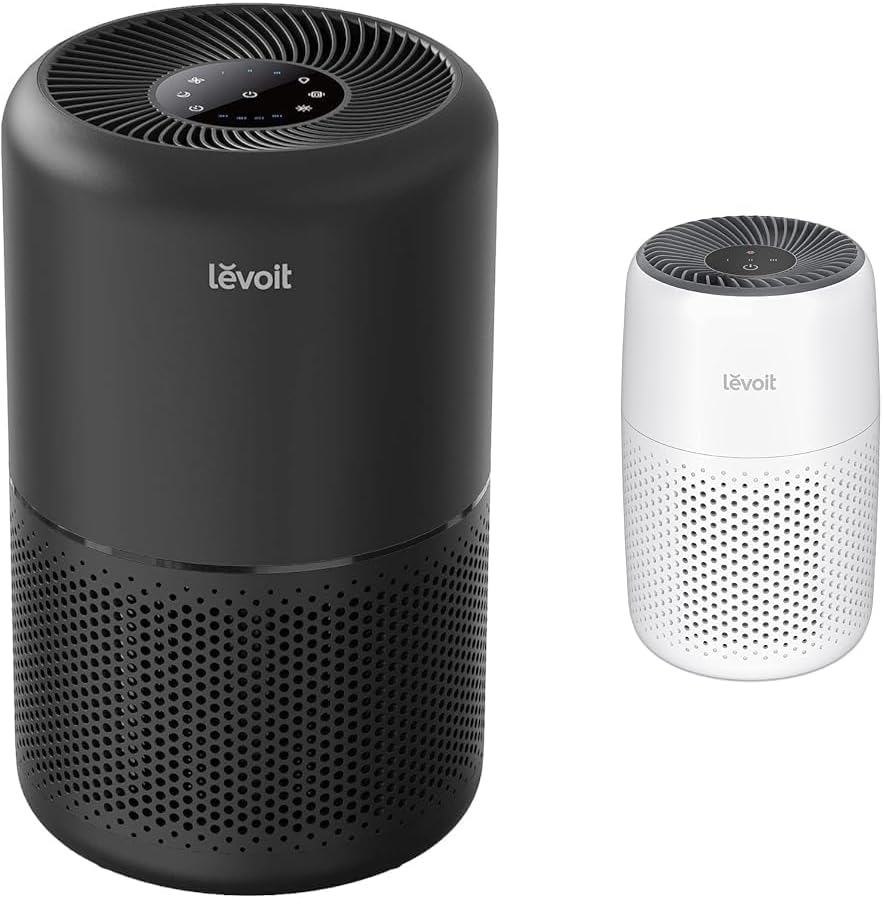
Levoit Core300-P
TechGearLab scored the Core300-P 71 out of 100, sixth of twelve units, and named it Best Bang for Your Buck. In a 200 sq ft chamber it cleared 63% of small particles and 75% of large smoke particles within ten minutes, which earned an air cleaning score of 8.1 out of 10, the category that carries 40% of the total. Its measured noise on low was 28.4 dB, rising to 54.2 dB on high; Levoit's own rating for the unit is 24 to 54.5 dB. Three fan speeds, a 2 to 8 hour timer, a sleep mode and a filter change indicator are all present.
Two caveats sit in the published record. TechGearLab notes that the filtration is HEPA-style rather than certified true HEPA, despite the marketing, while Consumer Reports describes the same unit as True HEPA plus activated carbon: sources disagree, and shoppers who need certification on paper should treat the claim as unsettled. The second is running cost. Consumer Reports puts electricity at $56 a year and filters at $60, about $116 a year in total; TechGearLab's estimate is $96.33. Either way the filters cost more over two years than the machine does.
Pricing spans a wide band. Consumer Reports lists it at $84.98, Levoit's own site at $99.99, TechGearLab at $100, and the Amazon listing this blog points to reads $148.97 as of September 17, 2026. At the low end of that range it is an easy purchase. At $148.97 it is worth checking whether the price has moved back down before buying, because nothing in the lab data justifies the top of the band.
It is the right unit for a bedroom, home office or nursery between roughly 150 and 260 square feet where the buyer wants a quiet overnight setting and does not want to think about it again until the filter light comes on.
- 8.1/10 air cleaning score from TechGearLab, the heaviest-weighted category in its test
- Quietest measured low setting of the pair at 28.4 dB (TechGearLab)
- Energy Star certified with a 2-year warranty and 30-day money-back guarantee (Consumer Reports, Levoit)
- Cleared 75% of large smoke particles in ten minutes in a 200 sq ft room (TechGearLab)
- TechGearLab found no true HEPA certification behind the HEPA-style filtration marketing
- 54.2 dB on high (TechGearLab), loud enough to be audible through a closed door
- About $116 a year to own once filters and power are counted (Consumer Reports)
- At 7.6 to 8 lbs it is carried between rooms rather than lifted with one hand
Levoit Core Mini-P
The Mini-P is not a bad product; it is a correctly engineered small one. TechGearLab scored it 65 out of 100, seventh of twelve, with 8.1 for noise and 8.7 for operating cost against 4.8 for air cleaning. It weighs 2.2 lbs, costs about $55.36 a year to run on TechGearLab's estimate, has a filter life near six months, and runs from a single button with no app, timer or sensor. TechGearLab's ideal coverage figure is 66 sq ft; Air Purifier First puts the non-smart Core Mini at 72 sq ft at 4.8 ACH.
The independent lab work on the Mini-P's sibling is the clearest warning. HouseFresh measured the Core Mini at 41 CFM for smoke-sized particles, a maximum of 61 sq ft at five air changes an hour, and a recommended 28 sq ft for best performance. In a 728 cubic foot test room it took 136 minutes to bring PM1 counts to zero. HouseFresh's verdict on it was blunt: "too small for medium to large rooms," with RVs, cars and very compact personal spaces named as the fit.
On price, TechGearLab lists $50 and Air Purifier First shows the Core Mini at $43.98, down from $49.99. Buy it for a dorm desk, a cubicle, a nightstand in a converted box room, or a vehicle. Do not buy it for a bedroom and expect it to behave like a bedroom purifier.
Four times the airflow for twice the money
Three things separate these units, and only one of them is size.
The first is airflow per dollar. At TechGearLab's list prices, the Core300-P delivers 143 CFM for $100 and the Mini-P 34 CFM for $50: about 1.43 CFM per dollar against 0.68. Doubling the spend buys slightly more than four times the clean air delivery. There is no configuration of a standard bedroom in which that is the wrong trade.
The second is noise, and it runs the opposite way to intuition. The Mini-P has the lower average, 36.5 dB against 43.1 dB in TechGearLab's measurements, and the lower ceiling, 42.3 dB against 54.2 dB. But on the lowest speed, the setting a sleeper actually uses, the Core300-P measured 28.4 dB and the Mini-P 32.1 dB. The compact unit is quieter only because it cannot work hard. Run flat out in a room it was never sized for, it is both louder than the big machine on low and slower than it on high.
The third is what the ratings do not show. The Mini-P's 4.8 out of 10 for air cleaning is not a failure of design, it is the score a 34 CFM unit earns in a test chamber sized for real rooms. Undersizing shows up as time, not as a warning light: HouseFresh's 136 minutes to clear a 728 cubic foot room is what a bedroom owner would experience as a purifier that never quite catches up.
When smoke pushes the budget up to the Core 400S
For households buying with wildfire smoke rather than dust and dander in mind, the Core300-P has a ceiling. TechGearLab's smoke result for it, 75% of large particles in ten minutes in 200 sq ft, is good for a bedroom and irrelevant to an open-plan living room.
The step up is the Levoit Core 400S. Air Purifier First lists it at 260 CFM and 403 sq ft, drawing 38W, against the Coway Airmega AP-1512HH at 233 CFM and 361 sq ft drawing 77W; in a 320 sq ft test room both improved air quality by 96%, and the Levoit cleared a smoke test box in 15 seconds to the Coway's 18. HomeEssentialsLab puts the two closer still, at 240/259/231 CFM for dust, pollen and smoke on the Levoit against 246/240/233 on the Coway, and concludes that "you will not notice a speed difference in how fast they clear the air."
Prices in those two comparisons diverge sharply, and this is where caution is warranted: Air Purifier First quotes the Core 400S at $189.99 and HomeEssentialsLab quotes the Core 400S-P at $84.99, with both putting the Coway at $229.99. The Coway's arguments are its three-year warranty against Levoit's two, an Eco mode that stops the fan entirely when the air is clean, and an ionizer. The Levoit's are roughly half the power draw and cheaper filters. For smoke specifically, the CADR figures say the Coway premium buys nothing.
The purchase to make
Buy the Levoit Core300-P for any bedroom between about 150 and 260 square feet. It is quieter than the Mini-P at the speed people sleep on, it scored 8.1 out of 10 for air cleaning against the Mini-P's 4.8 in TechGearLab's testing, and at Consumer Reports' $84.98 listing it costs less than a year of its own filters. Check the price before checking out: the Amazon listing read $148.97 on September 17, 2026, and at that figure the case is a good deal thinner than at $85.
Buy the Levoit Core Mini-P only for a space of 60 to 70 square feet or less, which in practice means a desk, a dorm room, a nursery corner or a vehicle. It is a well-made small machine that HouseFresh found takes over two hours to clear a modest test room. Move up to the Levoit Core 400S if the room is over 400 square feet, if the purifier has to cover an open-plan space, or if smoke is a recurring seasonal problem rather than an occasional one. The Coway Airmega AP-1512HH is worth its premium only to a buyer who specifically wants the three-year warranty, the ionizer, or a fan that shuts off completely.
The recurring cost, roughly $60 a year in filters on Consumer Reports' figures, is the same whether the unit is sized correctly or not. An undersized purifier does not save that money; it just spends it more slowly than it clears the room.
Comments
No comments yet. Be the first to comment!
Leave a Comment