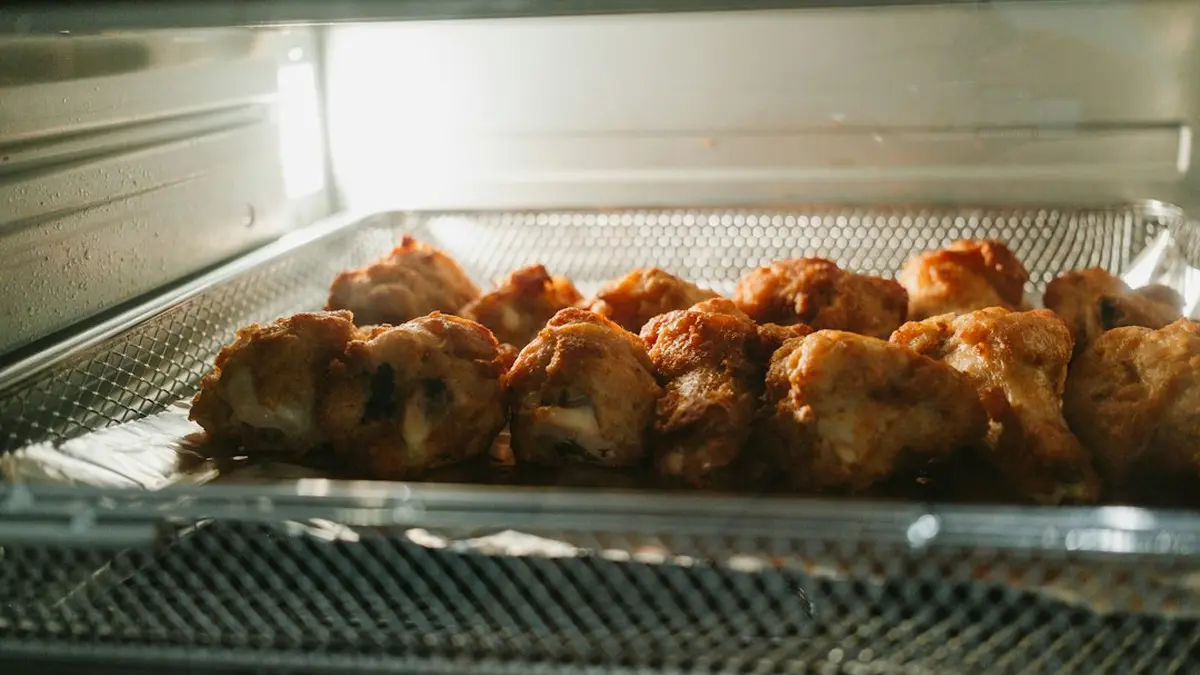
A turkey breast fits in a basket air fryer rated at roughly 5 quarts. A whole turkey needs about 12. The quart number printed on the box is still a poor guide to what will actually fit, because it measures the volume of the box and not the floor of the basket. This page is for the cook who already owns an air fryer and wants to know, a few weeks before Thanksgiving on November 26th, whether that machine can handle the turkey or whether the turkey should go back in the full-size oven.
The usual mistake is to read the capacity as a weight limit and the basket as a bucket. It works more like a floor. Hot air has to move around the meat, so the cut has to lie flat in one layer with space on every side and clear room above it. A wide 5-quart basket can take a 3-pound boneless breast comfortably. A deep, narrow basket with the same rating may not, and a whole bird of almost any size will not fit in either.
Why the quart figure misleads
The USDA's Food Safety and Inspection Service describes an air fryer as a countertop convection oven: a heating element and a fan that push hot air over the food. All of the browning and all of the cooking depend on that air reaching the surface of the meat. Anything that blocks it, whether a second layer of food, a cut pressed against the basket wall or a breast so tall it nearly touches the element, slows the cooking and makes it uneven.
That explains why sizing guides keep warning about the number on the box. Capacity in quarts or liters measures total internal volume, not usable cooking surface. A turkey breast cooks on its footprint, not its volume. Tasting Table notes that tapered or rounded basket bottoms make single-basket units look larger on paper than they cook. A 2026 compact-sizing guide goes further: square baskets give more single-layer surface than round ones of the same rating, wide and shallow baskets cook more evenly than deep and narrow ones, and a well-shaped 3-quart basket can beat a badly shaped 4-quart one.
Countertop air fryers come in three designs, and each handles a turkey differently.
| What matters for turkey | Single basket | Dual basket | Oven-style (racks and door) |
|---|---|---|---|
| Typical rating (BestReviews/KTLA; AislePrompt, Oct 2026) | About 2 qt for compacts; the largest single basket in an October 2026 roundup was 6 qt | 8 qt total, split as two 4-qt baskets in the example listed | Roughly 12 to 20+ qt |
| What fits (Real Homes; BestReviews/KTLA) | A breast or a crown with little room around it | A smaller breast in one basket, a side dish in the other | A breast with room to spare; the only design that can take a small whole bird |
| Limiting dimension (Air Fryer Insider; Tasting Table) | Floor area and wall taper | Each half is a narrow 4-qt space | Height between rack and top element, which should leave at least 1 inch |
| Useful space versus rating (Tasting Table) | Often less than the number suggests | Total rating overstates what one cut can use | Multiple racks generally give more usable space than a basket of the same rating |
Sizing the bird, then cooking it
The order matters. Measure the machine before buying the turkey, buy a cut that fits, then cook to a thermometer reading rather than a timer. None of it needs special equipment beyond what follows.
-
The air fryer's manual
Manufacturers often list a maximum food weight or size; Nebraska Extension and the USDA both say to follow it alongside federal guidance.
-
A tape measure or ruler
For the basket floor, not the outside of the machine.
-
An instant-read food thermometer
The only reliable test of doneness, according to the USDA and Nebraska Extension.
-
Refrigerator space for thawing
Frozen turkey should be thawed in the refrigerator, not cooked straight from frozen.
-
Air-fryer-safe parchment (optional)
Cosori suggests lining the crisper plate with it.
From measuring to carving
-
1. Measure the basket floor and the height
Measure the flat bottom of the basket, not the rim, and the distance from the floor (or rack) to the heating element. In an oven-style unit, The Air Fryer Insider recommends at least 1 inch between the top of the food and the element. It worked if the cook has two numbers on paper before going to the store.
-
2. Choose the cut to suit the basket
Well Plated, whose recipe was updated September 24, 2026 and tested in a 5.5-quart basket, gives two working ranges: a boneless breast or roast up to about 3 pounds, or a bone-in breast of 4 to 6 pounds with the rib bones removed so it lies flatter. It recommends at least 5 quarts for any breast and 6 quarts or more above 5 pounds. It worked if the cut, still wrapped, sits on the measured floor with space on all sides.
-
3. Thaw completely in the refrigerator
The USDA and the BestReviews guide both say to thaw fully in the refrigerator. A frozen center will not reach a safe temperature in a typical air fryer cook. It worked if the thickest part gives when pressed and has no ice crystals.
-
4. Trim to fit if needed
Removing the backbone or cutting a large breast in half helps it fit a smaller basket and cook more evenly, according to The Air Fryer Insider. Two halves cooked one after the other beat one half pressed against a wall. It worked if every piece lies in a single layer.
-
5. Preheat and load skin-side down
Well Plated preheats to 350°F for at least 5 minutes, then cooks skin-side down for 20 minutes. Cosori's own turkey breast recipe runs lower, at 330°F for 40 minutes, settings tuned to its own baskets. A light oil drizzle is enough, Cosori says. It worked if there is visible air space around the meat once the basket is closed.
-
6. Flip and keep cooking
Flip the breast and cook for another 30 to 50 minutes depending on cut and size (Well Plated). Its figures put a 3-pound boneless breast at about 1 hour to 1 hour 10 minutes in total, and a 4 to 6 pound bone-in breast at about 40 to 50 minutes. Those totals do not fully match its 20 minutes plus 30 to 50, which is one more reason to rely on the thermometer and not the timer. It worked if the skin is browning evenly on both sides.
-
7. Check the temperature in the thickest part
Insert the thermometer into the thickest part of the breast, away from bone, fat and gristle. The USDA safe minimum for all poultry is 165°F. Well Plated takes the turkey out at 160°F and lets carryover heat finish it during the rest. A cook who prefers not to rely on carryover can simply wait for 165°F before pulling it. It worked if a second reading in another thick spot agrees.
-
8. Rest, then carve
Well Plated rests the breast for 10 minutes in one place and at least 15 in its recipe card. Use the longer figure if it was pulled at 160°F, and confirm 165°F before carving. Cosori suggests the Keep Warm setting, where a machine has one, to hold the turkey without overcooking. It worked if the reading has reached 165°F and the juices stay in the meat when it is sliced.
After cooking, Nebraska Extension's Brenda Aufdenkamp gives the least glamorous instruction: "It is important to properly clean your air fryer basket/tray after each use." That matters more than usual on Thanksgiving, when the same basket will probably be cooking side dishes next.
Where it goes wrong
Overfilling. The USDA, Nebraska Extension and Cosori all name this first. A packed basket blocks the airflow the machine relies on, which leaves some areas undercooked and others pale, and Nebraska Extension warns it can stop food reaching a safe internal temperature at all. The sign is a breast that browns on top and stays pallid where it touches the wall. The remedy is smaller batches. For turkey parts, the USDA's advice is the same: cook several loads rather than one crowded one.
Trusting the dial. The temperature shown on the display is the air temperature the machine is aiming for, not the temperature of the meat, and extension sources cited alongside the USDA guidance report that displays can be 10 to 25°F away from the real basket temperature. Cosori's 330°F and Well Plated's 350°F are both reasonable settings. Neither replaces a thermometer reading.
Judging by color. Nebraska Extension states plainly that clear juices and firm texture cannot confirm a safe temperature. Only a thermometer reading of 165°F in the thickest part, clear of bone, can.
Cooking from frozen. Neither the USDA nor the BestReviews guide supports it. Turkey breast frozen at the center will brown outside long before it is safe inside. The USDA specifically warns against air-frying raw, stuffed, breaded poultry breast products from frozen, a category that includes some ready-to-cook holiday roasts.
Too little headroom. A tall bone-in breast in an oven-style unit can end up close to the top element. The Air Fryer Insider's rule is at least 1 inch of clearance. Without it the skin scorches before the meat is cooked, and Well Plated also warns against letting the breast exceed the basket's clearance from the element.
Leaving it alone. A breast that needs over an hour is a longer cook than most air fryers ever do, and the machine should be watched rather than left while everyone is in another room. The broader brief here mentions a history of air fryer recalls. The record in front of us for October 2026 is narrower and recent, and it involves exactly the kind of large oven-style unit that turkey cooks are tempted to use.
Cases that change the answer
Bone-in versus boneless. The sources' figures for minimum size differ, and the difference is mostly about bone. The BestReviews guide syndicated by KTLA says a breast needs roughly 4 quarts. The Air Fryer Insider says 3 to 5. Well Plated, which actually cooked one, says 5, and 6 or more above 5 pounds. A boneless roast of 3 pounds or less is compact and fits the smaller figures. A bone-in breast has a rib cage that holds it up off the floor, so it needs the larger figure and the ribs taken out. For a bone-in cut, the conservative 5-quart minimum is the sensible starting point.
Above 5 pounds. Well Plated moves to 6 quarts or more at that weight, and a 6-quart basket was the largest single basket in AislePrompt's roundup checked October 30, 2026. A breast above 6 pounds has run past what the sources say a basket can do. It needs halving or an oven-style unit.
A whole bird. BestReviews is blunt: "You'll need a model with a capacity of 12 quarts or larger for a full-sized bird." Real Homes, which judged machines specifically on turkey, found that most basket-style models fit only a turkey crown with a little room for trimmings around it. A 12-quart threshold excludes nearly every basket on a kitchen counter, so for most owners a whole turkey stays in the full-size oven. The Air Fryer Insider's 5 to 8 quart figure for a "small whole turkey" should be read as a very small bird and the upper end of that range.
Oven-style units. These measure their space differently: by the height between rack and element instead of basket depth, and multiple racks generally give more usable room than a basket with the same rating. For owners deciding whether a countertop oven is worth having for jobs like this, America's Test Kitchen's August 2026 test of air fryer toaster ovens is the place to begin.
Dual baskets. An 8-quart machine made of two 4-quart baskets is not an 8-quart machine for turkey. Each basket is a 4-quart space, which handles a small boneless breast in one side and a side dish in the other. It will not take a bone-in breast.
Small households. The compact-sizing guide calls 3.5 to 4 quarts the sweet spot for couples and says a 2-quart model feels limiting once larger portions come in. For two people, a boneless breast toward the small end of the 3-pound limit in a well-shaped 4-quart basket is realistic. A bone-in breast in that size of basket is not.
Parts instead of a breast. Turkey parts have no single-piece size limit, but the batch rule takes over. The USDA asks for smaller loads instead of one crowded basket, and a whole bird's worth of parts in a 5-quart basket means several rounds, each checked separately with the thermometer. The USDA's whole-turkey guide tests 165°F at the thigh, the wing and the breast, so each cut should get its own reading.
What it costs, and what it saves
The money involved is small and the timing is the real advantage. In Real Homes' guide, running costs for turkey-capable air fryers came to roughly 25 to 27 cents an hour in the US (the guide gives no date for that figure). A breast that cooks for about an hour therefore costs about a quarter in electricity. The USDA notes that air fryers cook faster and use less energy than a full-size oven, so the bigger benefit is that the main oven stays free for stuffing and pies.
The strongest argument against all this is that a full-size oven already exists, holds any turkey and never needs the bird cut down. That is correct, and for a whole bird it settles the question. A breast is different. A 3-pound boneless roast or a trimmed bone-in breast cooks in roughly an hour in a 5 or 6 quart basket, leaving the oven free for the four other dishes that need it on the one day of the year it is most in demand. The air fryer does not replace the oven, but it is a useful second one.
Comments
No comments yet. Be the first to comment!
Leave a Comment