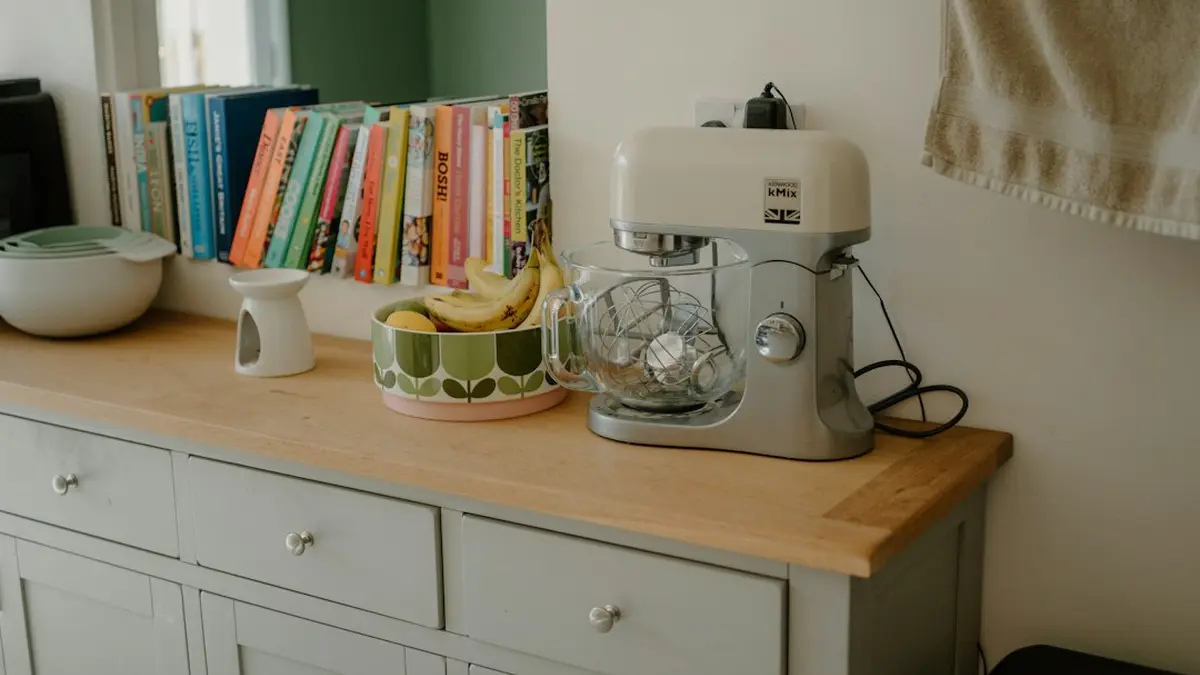
The number on a stand mixer's box is the least reliable figure a buyer will see. America's Test Kitchen advises subtracting roughly 2 quarts from any manufacturer's stated bowl capacity to estimate what the bowl can actually work. In its tests, a bowl sold as 4.5 quarts held 3.25.
Sizing a mixer therefore means three checks in a fixed order. First, size it by usable capacity and by what a batch produces. Second, treat wattage as a rough floor, not a ranking. Third, choose between tilt-head and bowl-lift by the dough the baker makes and the height of the kitchen cabinets. These checks matter most from October through December, when holiday discounts make the box figures look larger than they are.
How capacity and power interact
Capacity comes first because it decides everything else. A bowl's marketed volume counts space the beater cannot reach and dough cannot occupy without climbing the hook. ATK's 2 quart deduction is a rule of thumb, but its measurements support it. That deduction matters most at the small end, where a 2 quart shortfall can remove most of the bowl.
Power comes second, and here the spec sheet misleads most. ATK's buying criteria say torque predicts performance better than wattage. In its view, a 250 watt motor with strong torque can beat a 350 watt motor with weak torque. Reviewed goes further: "Neither wattage or bowl capacity is a good indicator of how a mixer will perform unless all other factors are identical. It's the overall design of the mixer that determines a mixer's efficiency." Torque is rarely printed on the box. Its absence shows up in use: ATK's testers watched under-torqued machines "rock and walk across the counter" during heavy mixing.
Current buying guides still repeat a rough pairing of bowl size and wattage. BlenderWise matches 4 to 5 liter bowls with 300 to 500 watts, 5 to 6 liters with 500 to 800 watts, and 10 liter bowls with 800 to 1,500 watts. Kitchen Gear Central puts the threshold for cookies and cakes at 300 to 400 watts and recommends 500 watts or more for bread dough and heavy batters.
The strongest objection is that wattage is the only power figure most buyers can compare, so it should count for more. That is partly fair. Within one design family, more watts does follow bigger bowls and heavier work. Prudent Reviews lists one maker's tilt-head motors at 250 to 325 watts. The same maker's bowl-lift motors are rated at 1.0 to 1.3 horsepower, or roughly 746 to 969 watts. Across brands and designs, however, the relationship fails, for the reason Reviewed gives. A buyer can use wattage to rule a mixer out. Wattage cannot rank the mixers that remain.
Three places the gap shows
The small mixer. ATK measured a compact tilt-head sold as 3.5 quarts at 1.9 quarts of usable volume, a loss of nearly half. A shopper who buys a small mixer for a small kitchen may find it holds less than one full recipe.
The popular midsize tilt-head. A 325 watt motor is the common rating among the best-selling 5 quart tilt-heads. Kitchen Gear Central warns that it "can bog down on very stiff bread dough." This mixer suits cakes well, and owners who buy it for bread are the ones who notice the limit. Some makers also restrict kneading to a low setting. ATK notes that KitchenAid limits kneading to speed 2, so a manual that says so is describing the design, not a fault.
The heavy-dough bowl-lift. More motor does not end the trade-offs. An owner roundup by KitchKap covers one popular 6 quart bowl-lift. That model uses a nylon worm gear designed to strip under overload so the motor survives. Owners report replacing the gear every 2 to 5 years of heavy use, at about $15 each time.
Tilt-head or bowl-lift
Buyers often treat head design as a power grade. It is a mechanical choice that usually comes with a power grade, which is different. ATK and Reviewed describe the split this way:
| Tilt-head | Bowl-lift | |
|---|---|---|
| How it opens | The motor head tips up and back | A crank or lever raises and lowers the bowl |
| Typical stated capacity | Tops out around 5 quarts | 5 to 8 quarts |
| Typical height | About 14 inches | About 16.4 to 17 inches |
| Clearance needed | Room overhead to tilt back | No tilt, but a taller machine overall |
| Weight and power | Lighter, less powerful | Heavier, more powerful |
| Suits | Cakes, muffins, mousses; easier to add ingredients mid-mix | Large batches and stiff bread dough |
Before the sale price decides
-
Subtract 2 quarts from the stated capacity
This follows ATK's rule of thumb. Judge the result against the largest recipe the baker makes.
-
Convert bowl size into batches
Shopping Picker puts 4.5 to 5 quarts at up to 8 dozen cookies and 3 quarts at a single batch or one loaf. Kitchen Gear Central puts 6 quarts at up to 13 dozen. BlenderWise places large bread and bulk baking at 7 to 8 quarts.
-
Use wattage only to rule a model out
300 to 400 watts covers cookies and cakes. Aim for 500 or more for regular bread. Look for test notes on stiff dough and on whether the mixer walks across the counter.
-
Measure under the cabinets
A tilt-head needs room to tip back. A bowl-lift needs room for a body around 16.5 to 17 inches tall.
-
Check the attachments and the manual
ATK found stainless steel attachments resist chipping better than coated aluminum. Also check which speed the manual allows for kneading.
The rule that matters most is to size a mixer for the stiffest dough it will knead regularly, measured in usable quarts. The holiday cookie run is the wrong benchmark, because a mixer that handles the hardest job will handle the rest.
Comments
No comments yet. Be the first to comment!
Leave a Comment